
Introduction: A Crisis of Trust in Financial and Institutional Systems
We are living in a time where trust in financial institutions and governance structures is increasingly fragile. Repeated scandals involving major banks and financial actors have exposed serious weaknesses in systems that were long considered pillars of stability and democracy. Cases such as Deutsche Bank (Germany) and controversies surrounding institutions like Banco Master (Brazil) point to recurring issues: misconduct, insufficient accountability, and decisions that at times prioritize profit over responsibility.
These problems should neither be minimized nor softened. Financial misconduct – especially when it involves large and influential institutions – must be addressed openly and critically. Attempts to downplay or obscure such issues only deepen the underlying problems and further erode public trust.
The consequences are not abstract. They are borne by ordinary citizens in the form of economic insecurity, reduced opportunities, and declining confidence in institutions that are supposed to serve society. This creates a growing imbalance, where the costs of systemic failures are often carried by the many, while responsibility remains diffuse.
In a world increasingly shaped by artificial intelligence, automation, and digital systems, this raises a fundamental question:
=> Can we build financial and governance systems that are not only efficient, but also transparent, accountable, and resistant to corruption?
It is within this context that new models such as Decentralized Finance (DeFi) and Decentralized Autonomous Organizations (DAOs) have emerged, challenging traditional systems and offering alternative ways to organize trust, value, and decision-making.
It is within this context of declining trust and rising technological change that new models are emerging, challenging traditional systems and offering alternative ways to organize finance and governance.
We are entering a new era shaped by artificial intelligence, automation, and global digital connectivity. As machines take over routine tasks and data becomes the most valuable resource, societies are being forced to rethink not only how economies function, but also how trust, governance, and fairness are organized.
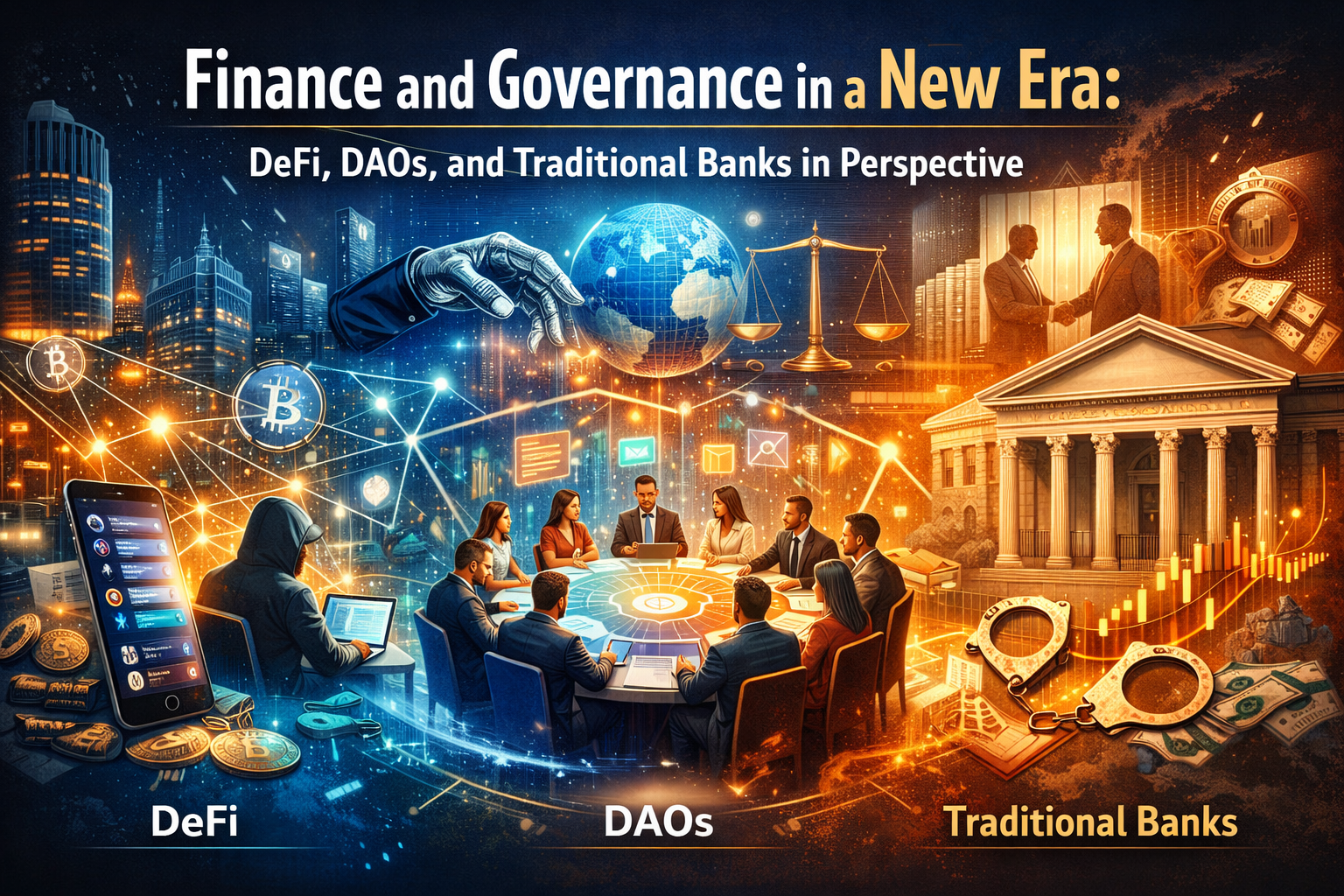
In this context, three systems stand at the center of transformation:
- Decentralized Finance (DeFi)
- Decentralized Autonomous Organizations (DAOs)
- Conventional banking systems
Rather than viewing them as mutually exclusive, the real opportunity lies in understanding how each contributes to a more efficient, ethical, and transparent future.
DeFi: Transparency, Accessibility, and Programmable Trust
DeFi represents a fundamental shift: financial services that operate without centralized intermediaries.
Key Advantages
- Transparency: All transactions are recorded on public blockchains, reducing hidden manipulation
- Accessibility: Anyone with an internet connection can participate—no bank account required
- Efficiency: Smart contracts automate processes, reducing costs and delays
- Financial inclusion: Opens opportunities for populations traditionally excluded from banking systems
Relevance in the New Era
In a world increasingly driven by AI and automation, DeFi introduces programmable trust – systems where rules are enforced by code rather than institutions. This reduces dependency on human discretion, which is often vulnerable to corruption or bias.
=> DeFi aligns with the need for fairer and more open financial systems, especially in regions where institutional trust is weak.
DAOs: Toward More Participatory and Transparent Governance
DAOs extend the idea of decentralization beyond finance into decision-making and governance.
Key Advantages
- Democratic participation: Members vote directly on decisions
- Transparency: Decisions and funds are visible on-chain
- Reduced hierarchy: Eliminates centralized authority structures
- Global collaboration: Enables borderless, community-driven organizations
Relevance in the New Era
As societies demand more ethical politics and real democratic participation, DAOs offer a model where:
- Decisions are not hidden behind institutions
- Power is distributed among stakeholders
- Rules are enforced transparently
=> While still experimental, DAOs represent a step toward more accountable and participatory governance systems.
Conventional Banks: Stability, Regulation, and Trust Infrastructure
Despite their limitations, traditional banks continue to play a critical role.
Key Advantages
- Regulation and protection: Consumer safeguards, fraud protection, and legal recourse
- Stability: Central banks and financial institutions help manage systemic risk
- Integration with the real economy: Credit systems, mortgages, and large-scale financing
- Trust for the majority: Many people still rely on banks for security and familiarity
Relevance in the New Era
As technology advances, stability becomes even more important. Fully decentralized systems can be volatile or complex. Banks provide:
- Risk management frameworks
- Bridges between digital and real-world economies
- Institutional accountability
=> In a rapidly changing world, banks remain essential for structure and systemic resilience.
A Complementary Future, Not a Competitive One
The future is unlikely to be dominated by a single system. Instead, we are moving toward a hybrid model:
- DeFi brings efficiency, openness, and innovation
- DAOs introduce new forms of governance and participation
- Banks provide stability, regulation, and large-scale coordination
Together, they can address key challenges of our time:
- Reducing corruption through transparency
- Expanding access to financial systems
- Enhancing democratic participation
- Supporting a global, AI-driven economy
Challenges and Responsibilities
However, this transformation is not without risks:
- DeFi can lack regulation and expose users to technical risks
- DAOs can struggle with decision-making efficiency and accountability
- Banks can resist innovation and maintain legacy inefficiencies
=> The central challenge is not technological—it is ethical and institutional design.
Conclusion: Building Trust in the Age of Technology
As AI and automation reshape economies, the fundamental question becomes:
How do we build systems that are not only efficient, but also fair, transparent, and trustworthy?
- DeFi shows that trust can be encoded
- DAOs show that governance can be shared
- Banks show that stability and regulation still matter
The future will depend on combining these strengths to create systems that serve not just efficiency—but society as a whole.
=> In this new era, the goal is not simply innovation, but the creation of systems worthy of trust in a world increasingly run by technology.